|
Jewish
Marais |

.... |
By Toni L.
Kamins ©
Toni L. Kamins is a freelance journalist, and former editor. She
is also the author of the Complete Jewish Guide to France and the Complete Jewish
Guide to Britain and Ireland (St. Martin's Press). You can learn more about
her and her books here: www.tonikamins.com |
There have been Jews living in Paris on and off since the region was conquered
by Rome in the first century BC. Small Jewish communities in those early centuries
could be found in what is now the fifth arrondissement in an area just south
of the Seine near where the Church of St. Julien le Pauvre now stands. There
is some evidence to suggest that a synagogue once stood on the same site.
In the tenth and eleventh centuries, there was a small Jewish
community on rue de la Harpe between rue de la Huchette and rue Saint Severin
and then on a street called rue de la Vielle Juiverie (Old Jewry street) that
lay between the present rue Saint Severin and rue Monsieur le Prince. At the
corner of Blvd St. Michel and rue Monsieur le Prince there was a Jewish cemetery,
and nearby a synagogue. Another Jewish cemetery was located on the tiny rue
Pierre-Sarazin just off Blvd. St. Michel.
. .
By the twelfth century when Benjamin of Tudela (in Spain), who
traveled all over the known world and chronicled its Jewish communities, came
to Paris he was able to call it Ha-ir Hagedolah (Hebrew for 'that great city'). The Jewish community, which was then living on the Ile de la Cité,
would have greeted him and he would have stayed with them in the Jewish quarter
– an area within rue de la Cité (then called rue des Juifs), Quai
de la Corse, and rue de Lutece. Place Louis Lepine, where the Marché
aux Fleurs now stands, was the site of the community’s synagogue.
A late twelfth century Jewish community also could be found in
the area delineated now by rue de Moussy, rue du Renard, rue Saint Merry, and
rue de la Tacherie, and also on the Petit Pont. In those days, Paris’
bridges were just like streets and were covered with houses. Indeed at the time
Jews lived on many other streets and there were place names such as Moulin aux
Juifs (Jews windmill), Ile aux Juifs (Jews Island), and Cour de la Juiverie
(Jewish court). By the thirteenth century the community had moved to the Marais
(now the third and fourth arrondissements) where they lived at the time of the
expulsion of 1306.
. .
During the periods between expulsions Paris’ rabbinate
was highly regarded in the Jewish world. The city was home to a number of noted
Jewish scholars among them Rabbi Shlomo ben Meir known as the RaSHBaM, Rabbi
Jacob ben Meir Tam, Mattathias Gaon, Chaim ben Hananel ha Kohen, Elijah ben
Judah, Jacob ben Simeon, and Rabbi Yehiel of Paris, the thirteenth century head
of Paris’ distinguished yeshiva (rabbinical academy).
When Jews began to return to Paris following emancipation in
the early nineteenth century they settled again in the Marais.
While Paris has been a place of Jewish prosperity, scholarship,
and greatness; it has also seen a lot of Jewish tears. For centuries the Jewish
community lived within France only at the sufferance of the king. Expulsions
were common, and it was not until the French Revolution and then Napoleon Bonaparte
that Jews finally had some measure of civil and religious freedom.
Today visitors will find Jewish communities throughout Paris
and its environs, but the largest Jewish neighborhoods are in the 4th, 9th,
11th, 13th, 19th, and 20th arrondissements. And indeed when you walk around
Paris Jewish history is all around – if you know where to look.
Jewish
Marais Walking Tour : Start
at The Ile de la Cite (Metro: Cite)
. .
The city’s most famous Jewish neighborhood is in the Marais
and is known as the Pletzl – Yiddish for little Place. This 4th arrondissment
district (Metro: St. Paul) has been home to Jews on and off since the thirteenth
century. Today, though gentrification has made this one of the city’s
most fashionable quarters, it is still heavily Jewish and has been for nearly
one hundred years.
Up and down rue des Rosiers between rue Malher and rue
des Hospitalières-St.-Gervais, as well as on the streets off
rue des Rosiers, you will find Jewish restaurants, bookshops, boulangeries and
charcuteries along with synagogues and shtiebels (small prayer rooms –
Oratoire in French).
The square in front of Notre Dame, known as the Parvis, is the
place from which all distances in France are measured.
Notre Dame de Paris
Notre Dame de Paris is one of the most famous sights in all Paris and certainly
one of the most spectacular. Its imposing stone façade, towers, and flying
buttresses have been painted and photographed from every conceivable angle.
It may surprise you that this standard bearer of the Roman Catholic Church in
France also holds some interest for Jews.
In front of the cathedral you can easily see two female figures on either side
of the central portal: They are known as Ecclesia (on the left) and Synagoga
(on the right). Ecclesia, a beautiful woman wearing a crown, represents the
Roman Catholic Church; Synagoga, a woman with a bowed head, shattered staff,
the broken tablets of the Ten Commandments at her feet, and a serpent around
her eyes represents Judaism. These two figures are common in church architecture
throughout much of Europe and represent the age-old religious conflict between
Christianity and Judaism.
Memorial to the Deported
........... ...........
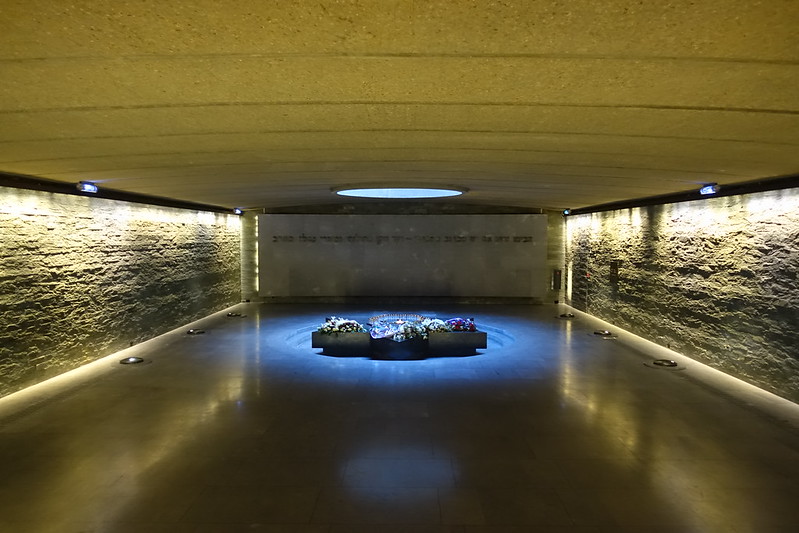
Behind Notre Dame across rue de l’ Archeveché, is
Square de l'Ile de France. A small gate on the right side of the Square leads
to a memorial to the unknown World War II deportee. Inside are the names of
the German death camps where 200,000 French men, women, and children, Jews and
Christians, were murdered. As you leave, the French words above the door speak
volumes – “Forgive, but do not forget!"
Exit the square, turn right, and walk along rue de la Archeveche
to the Pont St. Louis (a foot bridge), which will be on your right. Cross it
and you’ll be on the Ile St. Louis, one of Paris’ most charming
neighborhoods. This is a good place to stop and just enjoy the city around you,
or take a stroll up and down rue St. Louis-en-l’Ile, stop for a snack,
or just take in the atmosphere.
Once you have crossed the bridge, bear left onto rue Jean-du-Bellay
and continue on as it becomes Pont Louis Phillipe. Walk across the bridge to
the other side of the Seine and continue as the street becomes rue du Pont Louis
Phillipe. At rue de Hotel de Ville make a right turn, walk one block, and turn
left onto rue Geoffrey l’Asnier.
At # 17 is the Memorial of the Unknown Jewish Martyr (Tel: 01-42-77-44-72). This is one of the most moving Jewish sites in Paris.
It stands as a memorial to the nearly six million Jews who were murdered by
the Germans and their accomplices. Begun in Grenoble during World War II as
a means of documenting German atrocities, the museum has been expanded over
the years since it was built in 1956 and contains displays of documents and
photographs of Nazi camps. The building also houses a library and archives and
is a valuable research institution. (Note: at press time the memorial is closed
for renovation.
Exit the memorial onto rue Geoffrey l’Asnier and turn left.
Walk to the end of the street, turn right onto rue Francois Miron and then left
onto rue Tiron. Walk the short distance to rue de Rivoli, cross the street,
and turn right until you get to rue Pavee.
The Pletzl
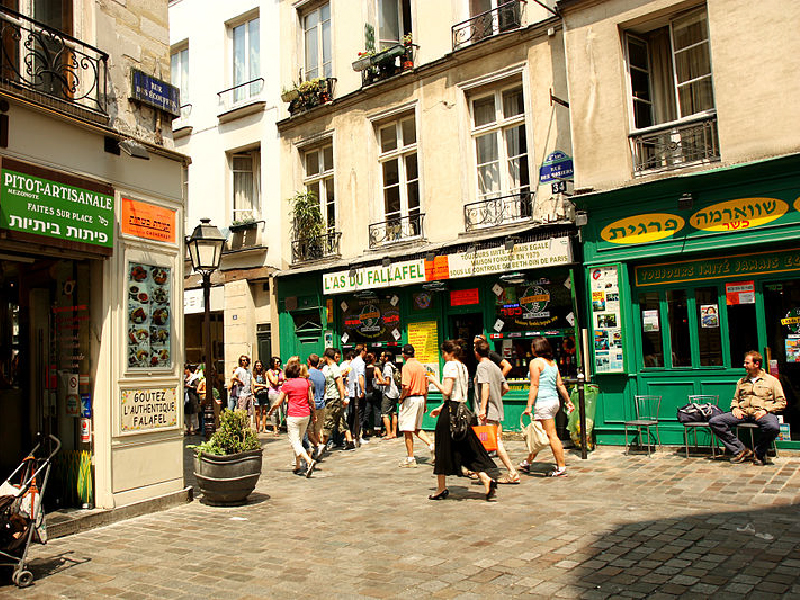
You will find many Jewish shops and restaurants here. Jews have
lived around here since the early twentieth century, but this was a Jewish neighborhood
in the middle ages too. Known as La Juiverie (the Jewry) in the thirteenth century,
it was a thriving and fairly self-sufficient community complete with synagogues,
cemeteries, and food manufacturers. Some of the street names from that early
period survive.
Until the late seventeenth century this district was full of
grand mansions and beautiful vistas – the center of residential life for
Paris' movers and shakers. But in the 1680s the French court moved from the
Louvre (then a royal palace) to Versailles and the rich and powerful moved away
from the Marais in order to be closer to Court. As is the case of many fashionable
neighborhoods throughout history and throughout the world, the exodus of the
moneyed classes signaled the decline of the Marais as a desirable spot to live.
.......... ..........
When the nineteenth century brought industrialization to Western
European cities, the mansions of the Marais were carved up into small apartments
and workshops. It wasn't long before crowded conditions became even more so
as hovels cropped up in courtyards, in the fronts of houses, and even on rooftops.
The once glitzy Marais had become a fetid slum with precious little sunlight
shining through. Many of the residents were Jews, the descendents of those who
had been expelled from France in the twelfth century by Phillipe-Auguste.
But look around you. Urban history has interesting twists and
turns. The Marais is now one of Paris' trendiest quarters and real estate prices
here are very high as successful artists, media types, and celebrities vie for
a piece of this historic area.
Paris’ new mayor, Bertrand Delanoe (elected
in 2001) is trying to improve this area and solve the traffic problem by turning
some streets into a pedestrian district. As one can guess there is considerable
debate about what should or should not be done. Some have greeted the plan with
enthusiasm, while others fear that that this piece of old Paris and of Jewish
Paris will be destroyed as a result.
As you walk look for plaques on some buildings commemorating
individuals and families who were deported and did not return.
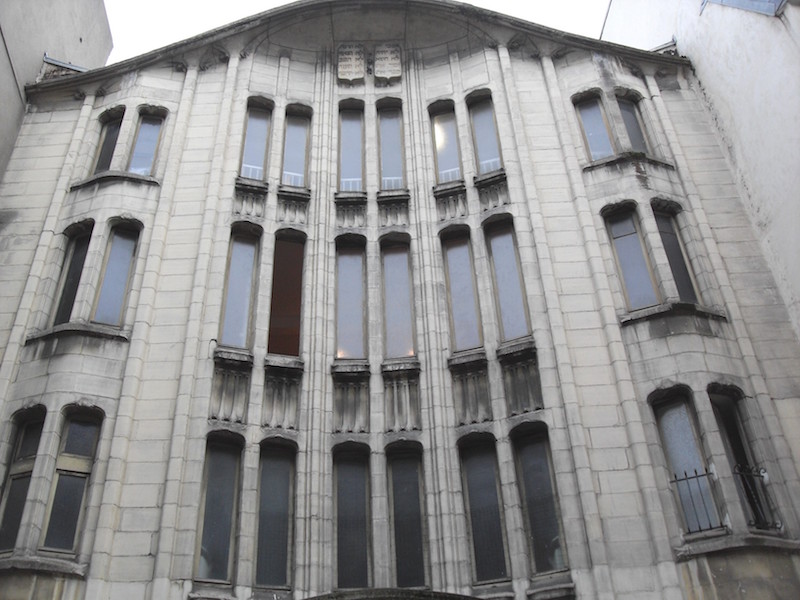
Turn left on to rue Pavée. At number 10 is Agudath Hakehilot, an orthodox
synagogue. Designed by Hector Guimard, the Art Nouveau architect
and decorator famous for the Paris metro stations, and built in 1914, this is
the largest synagogue in the Pletzl. Guimard's wife, an American, was Jewish
and with the rise of Nazism they left France for the United States. On Yom Kippur
1940 it was dynamited by the Germans, but has since been restored and is now
a national monument in addition to playing a key role in the community.
........... ...........
Continue along rue Pavée and turn left onto rue des Rosiers.
Along this narrow, ancient street you will find kosher and Jewish style restaurants
cheek by jowl with Jewish bookshops, small synagogues, prayer rooms, and kosher
boulangeries and charcuteries. You will also see trendy shops, a sign of the
increasingly gentrified nature of the neighborhood.
On your left, off rue des Rosiers, is rue Ferdinand Duval,
until 1900 rue des Juifs. The rear of the courtyard of number 20 (the door may
be locked), contains a sixteenth century Hotel Particulière (private
house) known as the Hotel des Juifs. Now owned by an artist, it is a remnant
of a Jewish community of the eighteenth century composed of Jews from eastern
France and Germany.
Retrace your steps back to rue des Rosiers,
turn left, and continue to rue des Ecouffes (street of kites – a bird
of prey and an archaic and derisive term for pawnbroker). There are a number
of orthodox synagogues along this short street. Notice the posters of the late
Lubavitcher Rebbe, Menachem Mendel Schneerson. Many Lubavitcher Hasidim live
in this neighborhood and their worldwide followers are a strong presence here
and elsewhere in Paris.
Go back to rue des Rosiers, turn left, walk to rue des Hospitalières-St.-Gervais,
and turn right. Number 6 is a Jewish boys school. The plaque on the wall commemorates
the students and teachers who were sent to the internment camp at Drancy (outside
Paris) and then to Auschwitz where they were murdered. One hundred sixty five
boys were deported from here despite the headmaster's efforts to save as many
as he could.
The final stop on the walk is the Museum of Jewish Art
and History. (71, rue de Temple), Metro: Hotel de Ville. Musee de l'Art
et d'Histoire du Judaism, www.mahj.org).
Opened to much publicity in December 1998, the museum is dedicated to the celebration
of Jewish life in the extensive picture exhibits and collection of ritual objects.
From 6, rue des Hospitalières-St.-Gervais walk up to the
end of the street where it meets rue des Francs Bourgeois and turn left. Continue
along as the street becomes rue Rambuteau on the other side of rue des Archives.
Turn right onto rue de Temple. (note: don’t confuse rue de Temple with
rue Vielle du Temple, which is also in this same area). The Museum of Jewish
Art and History is on the left side of the street in the Hotel Saint
Aignan.
Bookstores
Bazar Suzanne, 14, rue Ferdinand
Duval, Tel. 01 48 87 34 84 or 06 60 58 34 84
Bibliophane, 26, rue des Rosiers,
Tel. 01 48 87 82 20
Chir Hadach, 1, rue des Hospitalières
Saint Gervais, Tel. 01 42 72 38 00
Diasporama, 20 rue des Rosiers,
Tel. 01 42 78 30 50
Kosher Restaurants
Musee de l'Art et d'Histoire du Judaïsme,
café on ground floor ( lunchtime and afternoons only )
Les Tables de la Loi - 15, rue Saint Gilles, Tél. 01 48 04 38 02.
Essen Bench - 8, rue Pavee, Tel:
01 42 71 50 00
La Piccola Strada - 5, rue des Ecouffes,
Tel: 01-44-54-94-60
Contini - 42, rue des Rosiers, Tel:
01 48 04 78 32
L’As du Falafel - The most
famous falafel to take away, rue des Rosiers
Is France Anti-Jewish?
By Toni Kamins. © August 2004
Is France anti-jewish ? The answer is not simple. Yes France has had
a terrible history with the Jews living within its borders, with its Jewish
citizens, and with the Jewish people in general.
Jews have lived in France roughly since the fifth century and for most of that
time they were subject to government-sponsored vilification of their faith,
mass expulsions, forced conversion to Roman Catholicism, crippling taxation,
humiliating legal oaths, life in cramped ghettos, economic segregation, proscriptions
from living in France's major cities, blood libel accusations and trials, and
both systematic and random physical violence and murder. The end of the nineteenth
and early twentieth centuries brought us the Dreyfus Affair,
and World War II and the German occupation saw France collaborate
with Nazi Germany in committing heinous crimes against Jewish citizens of France
and Jews from other countries who were living in France.
But that does not automatically mean that the anti-Jewish violence in France of the past few years is a continuation of that shameful
history. One must look at other aspects of French society.
The sad truth is that France has never wanted immigrants
from North Africa and other Muslim countries. Nonetheless today France
is home to over seven million Muslims.
For decades Muslims from France's former colonies in North Africa
have settled in France and for all that time they have been relegated to living
in the suburban communities outside Paris and other large cities. These suburbs,
government housing projects, are not pleasant places to live. Unemployment is
high, education is an afterthought, access to mainstream French society is nearly
impossible, and being arrested for suspicion of this or that is common So it
is no surprise that crime, drugs, and other social problems are rampant.
The violence against Jews and Jewish buildings that has arisen
over the past three years is occurring within this environment and not
because the French have somehow taken to anti-Jewish violence once again.
And while the problem is a serious one and one that should not be taken lightly
or swept under the carpet, the fact is that this violence occurs in
places where tourists and visitors do not go. In other words the streets
of Paris are just as safe as they always were. One should also not assume from
this that every single Muslim in France is committing these terrible
acts. Nothing could be further from the truth. The violence is being
committed by a handful of thugs.
This is not to say that there are no anti-Semites in France.
There are. But there are anti-Semites in every country just as there
are people in every country who hate all kinds of people for one reason
or another.
Paris, Marais district is a vibrant and cosmopolitan
place where Jewish shops and residences exist side by side with art galleries,
boutiques, fine restaurants of all kinds, and tourists and residents
shopping and strolling and enjoying all that Paris has to offer.
A
Mayor of Paris "Dit Non"
By Adrian Leeds
A few weeks ago I spotted a lit poster on boulevard Beaumarchais
that read:
"Paris dit NON à l'antisémitisme, au racisme,
à toutes les discriminations!" signed, Mairie de Paris
Turns out, the posters are all over town and the city means what
they say, down to the grass roots level. Following the celebration of Americanism
sponsored by the Mairie of the 3rd arrondissement this past weekend as "Les
Nuits Americaines," it fascinated me to learn more about who's at the helm
of these bold events and ideas. I see Mayor Pierre Aidenbaum Head of the 3rd arrondissement,
from time to time on rue de Bretagne, dining in Chez Omar, or officiating at
local events. He seemed to be very much at the forefront of this very active
community, especially on these issues - then I discovered that he is Jewish,
born during World War II when his family fled to Au Puy to escape the Vichy
government, and is the head of the International League Against Racism and Anti-semitism,
a devoted socialist and radically left.
I set out to learn more and was graciously invited to meet with
Mayor Aidenbaum and his press secretary, Cyril Egner. With the assistance of
Pascal Fonquernie, long time resident of Le Marais and manager of www.parismarais.com
web site, we visited with them both in the Mayor's grand office on the second
floor of the Mairie de 3ème yesterday afternoon.
We sat around a large round table, spoke in French and posed
many questions. Mayor Aidenbaum spoke openly and freely, particularly animatedly
on the question of anti-semitism and the activities which have blackened France's
name, especially with the American Jewish community, from whom I hear regularly.
He believes the media is guilty of not telling the full story and he confirmed
our own feelings -- the extremist aggressive behavior perpetrated mostly by
youths from the suburbs are an extension of the Israeli-Palestinian conflict.
There is more anti-Israeli policy sentiment than anti-Jewish sentiment. There
haven't been any anti-semitic activities in the 3rd, and he doesn't believe
for a moment that the French are specifically anti-semitic -- not any more than
they are anti-anything, and their dislike of other religious or ethnic groups
forms a hierarchy, one more profound than the other.
Mr Aidenbaum's not worried about the future of the Jewish community
in France, or the tension we're now experiencing between the U.S. and France
-- he has an optimistic outlook that there will be resolution thanks to this
being a very multi-cultural society, evidenced by events organized and supported
by the state such as Les Nuits Americaines, the annual Chinese New Year Parade
and a host of others. The 3rd abounds with cultural centers, too: Swiss, Mexican,
German, Swedish and many others -- almost 30% of the "quartier" is
Chinese and overall very "mixité" (like a melting pot). Pascal
interjected that in his own building on rue Charlot, there are Germans, English,
Americans, French, old and young, gay and straight, in newly redecorated apartments
and 1948 rent-control apartments -- very "mixité" indeed ! |
|
|